
Clear English. Clear plans. Calmer travel.
Choose a driver who can explain the journey—not just drive it.
A few friendly messages are not enough to prove that communication will work for a multi-day trip. Use this guide to test route planning, meeting instructions, changes and emergency support before you book.
- English consultation
- Government-authorised drivers
- Guide-driver options
Finding an English-speaking driver in Sri Lanka is easy to describe and surprisingly difficult to evaluate. Many profiles say “English-speaking,” but that phrase can mean anything from basic greetings to confident discussion of a ten-day itinerary.
For a simple airport transfer, basic English may be enough. For a private circuit through Sigiriya, Kandy, Nuwara Eliya, Ella, Yala and the south coast, communication has to carry much more weight. You may need to agree on departure times, find each other in a crowded terminal, discuss a route change, explain dietary or mobility needs and respond calmly when weather alters the plan.
What “English-speaking driver” should mean in practice
An effective English-speaking driver does not need perfect grammar or a particular accent. The practical standard is mutual understanding. Both sides should be able to confirm a decision without guessing.

Start with a short written test
Send the same concise enquiry to every candidate. Keep it specific enough to reveal whether the reply is thoughtful. A reliable answer should address your actual route rather than return a generic price and “yes, possible.”
Include your arrival date and flight time, number of travellers, luggage, overnight stops, final drop-off and two questions that require explanation. For example, ask whether Kandy to Ella should be done entirely by car or combined with the train, and ask what happens to the driver and luggage if you take the train.
The quality of the answer matters more than speed alone. Look for a reply that notices difficult days, separates included and excluded costs and asks sensible follow-up questions. If the writer misunderstands the sequence of cities or ignores half the message, the same pattern may continue on the road.
Seven questions that reveal real communication ability
- “Could you repeat our itinerary in your own words?”This quickly shows whether the route was understood rather than copied.
- “Where exactly will we meet at the airport?”A useful answer names the terminal area, sign or contact method and what to do if the flight is delayed.
- “Which day looks too long, and how would you improve it?”A professional should be willing to identify an unrealistic plan.
- “What is included in the price?”The reply should deal with fuel, expressways, parking, driver accommodation, time or mileage limits and any excluded attraction fees.
- “How do we request a change during the trip?”Confirm who approves it, how any extra cost is calculated and how the new plan is recorded.
- “Who do we contact if we cannot reach the driver?”A backup contact is especially valuable for airport days and multi-day tours.
- “Can you send the driver’s full name and registration details before arrival?”The answer should be direct and verifiable.

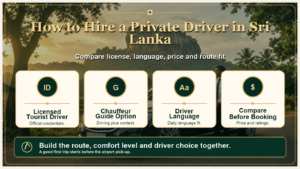
Licence and language are separate checks
English ability does not prove professional registration, and registration does not guarantee that a particular communication style suits you. Check both.
Sri Lanka Tourism provides a public directory of authorised Tourist Drivers that can be searched by name or registration number. It also provides a directory of licensed Tourist Guides with a language filter. If you want the driver to provide formal cultural guiding—not only transport and practical conversation—ask whether the person is a licensed Chauffeur Tourist Guide and verify the category.
A screenshot of an old card is not the strongest evidence. Ask for the current full name and registration number, then check the official directory yourself. Also confirm which individual will actually arrive: a company’s credentials do not automatically apply to every substitute driver.
Watch for these communication red flags
- The reply says only “yes” to a complex route without discussing driving times.
- The price is quoted without saying what is included.
- The driver’s identity or registration will not be shared before arrival.
- Important answers change between email, WhatsApp and the final quotation.
- Every question is redirected to a different person with no single written summary.
- You are pressured to pay before the route, vehicle and cancellation terms are clear.
Minor grammar errors are not a red flag. Evasive answers, inconsistent facts and unexplained changes are. The aim is not to grade someone’s English; it is to decide whether your trip can be coordinated safely and comfortably.

Create a simple communication system for the trip
Once you book, reduce future misunderstandings with one shared written plan. Keep hotel names, dates, approximate departure times, train sectors and important phone numbers in a single message or document. Ask the driver or coordinator to acknowledge the final version.
Use live-location sharing only when it is helpful for a pickup, and avoid relying on voice calls for complex changes. After discussing a change, send one short confirmation: “To confirm, tomorrow we will leave at 7:00, visit Dambulla first and arrive in Kandy before dinner.” Written summaries give both sides something concrete to follow.
Families should state child-seat and luggage needs with numbers, not general words such as “a lot.” Older travellers should mention walking limits and the need for frequent rest stops. Travellers with dietary restrictions should describe what must be avoided rather than assuming a single label will be interpreted the same way.
Copy-and-send English enquiry template
Hello,

We are looking for a private driver in Sri Lanka.

Travel dates: [dates]
Number of travellers: [number]
Luggage: [number and size]
Route: [city] → [city] → [city]
Arrival flight and time: [details]
Final drop-off: [place and time]

Could you please confirm:
1. Whether this route is realistic
2. The vehicle type and luggage capacity
3. What the quoted price includes and excludes
4. The driver’s full name and registration category
5. How itinerary changes are handled
6. Who we contact if we cannot reach the driver

Please reply with the route in your own words so we can confirm that we understand each other correctly.

Thank you.

Where LankaMe fits into the shortlist
For travellers who would rather discuss the route with a platform before being matched with a driver, LankaMe is one option worth comparing. Its relevant strengths for this particular search are English-language consultation, access to government-authorised Tourist Drivers and the ability to request a qualified guide-driver when formal guiding is important.
That does not remove the need to read the quotation, verify the assigned person and confirm the vehicle. It does make the early conversation easier for travellers who want one place to explain dates, group needs and route priorities. Our independent LankaMe private-driver guide explains how the service works and which questions to include in an enquiry.
The bottom line
The best English-speaking driver is not necessarily the person with the largest vocabulary. It is the professional who listens, checks assumptions, communicates changes calmly and leaves important agreements in writing.
Test the communication before you book. Verify the registration separately. Confirm the exact driver, vehicle, price inclusions and backup contact. Those few steps turn “English-speaking” from a vague marketing phrase into a practical standard for a smoother Sri Lanka journey.
Driver registrations and licence validity can change. Use the official Sri Lanka Tourism and SLTDA directories as the final reference at the time of booking.




 English
  German
  Chinese
  French
  Italian
  Spanish
  Dutch
Dutch  Malay
Malay  Thai
Thai
コメント